


The Last Gladiator

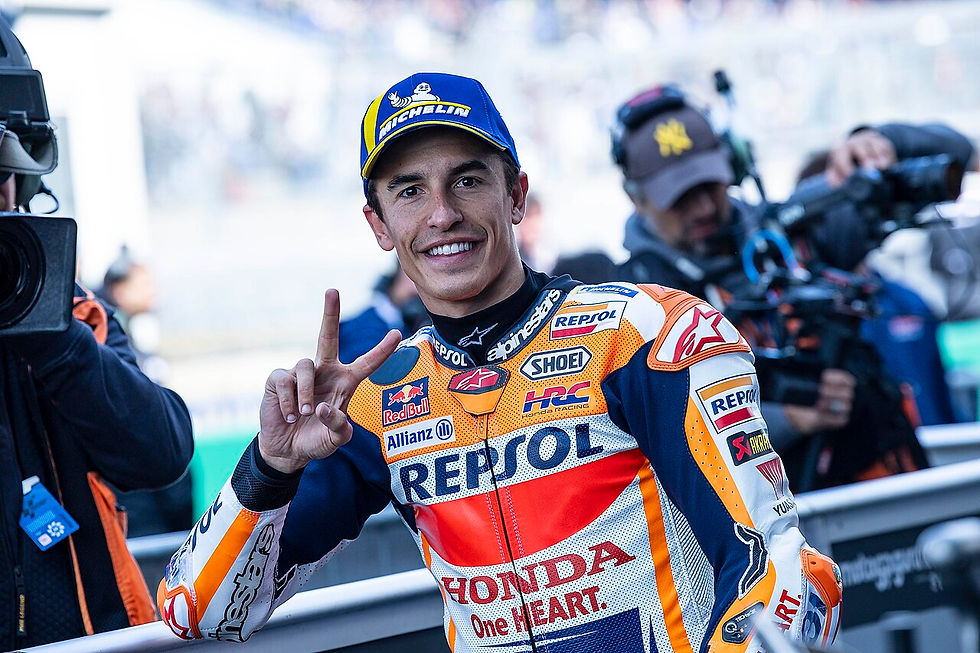
There are racers who win, there are racers who dominate and then there are racers who seem almost impossible. Marc Márquez belongs to the last category. To some fans, he is a genius. To others, a madman. But to the world of motorcycle racing, Márquez became something undeniable: the rider who redefined what was physically possible on a MotoGP bike.
Born in Cervera, Spain, in 1993, Marc grew up surrounded by motorcycles from the beginning. Racing wasn’t a hobby in the Márquez household, it was a way of life. Alongside his younger brother, Álex, Marc spent his childhood chasing speed with a level of obsession most people could never understand.
Very early on, people noticed something different about him. He crashed often, he rode aggressively, he saved impossible situations that should have ended in disaster. And somehow, he was still faster than everyone else.
By the time Márquez arrived in the world championship paddock, the sport was already filled with legends. Riders like Valentino Rossi, Jorge Lorenzo, and Dani Pedrosa had defined an era of MotoGP with precision and experience. Then came the kid from Cervera, and everything changed.
The Arrival
Marc exploded through the smaller categories with a style nobody could ignore. He won the 125cc World Championship in 2010 and later captured the Moto2 title in 2012, but MotoGP was where the world truly met him.
In 2013, riding for the legendary Repsol Honda team, Márquez entered MotoGP as a rookie.

Most rookies spend years adapting to the premier class. Marc attacked it immediately.
That same season, he became the youngest premier-class world champion in history.
Not because he rode safely. Because he rode like he had nothing to fear.
He leaned farther.Braked later. Saved slides that looked impossible. And attacked corners with a violence the sport had rarely seen.
Fans watched in disbelief as Márquez repeatedly lost the front tire, nearly crashed, somehow recovered, and kept pushing.
Soon, riders weren’t just racing Marc Márquez. They were trying to survive him.
The Era of Domination
Between 2013 and 2019, MotoGP largely became the Marc Márquez era.
He collected championships with brutal consistency and created some of the most iconic moments in modern racing. Entire races became psychological warfare. Competitors knew that even if they were faster early, Márquez would still be there in the final laps, waiting.
And when the pressure peaked, Marc often became even more dangerous.
His rivalry with Rossi became one of the most controversial chapters in MotoGP history. Fans divided into camps. Arguments exploded across the racing world. Every overtake, every contact, every interview became global news.
But controversy only made Márquez bigger.
To younger riders, he became the blueprint of modern aggression. To older fans, he represented a new generation willing to risk absolutely everything to win.

The Crash That Changed Everything
Then came 2020. At the Spanish Grand Prix in Jerez, Márquez suffered a violent crash that shattered his arm. Most riders would have disappeared quietly to recover.
Marc tried to return almost immediately.
That decision would change the next several years of his life.
The injury became a nightmare. Surgeries followed, then more surgeries, complications appeared. At times, there were real questions about whether he would ever return to elite racing again.

For the first time in his career, Márquez looked human. The rider who once seemed invincible suddenly struggled to finish races. Younger competitors took over the championship fight while Marc battled pain, uncertainty, and physical limitations few fans fully understood. But what made his story legendary was not the championships,
it was the refusal to quit.
Reinvention
Most champions fade away when the body stops cooperating. Márquez refused to disappear.
He rebuilt his riding style, relearned his physical limits, adapted his approach, and after years of setbacks, surgeries, and criticism, he fought his way back to the front of MotoGP.
Not as the fearless kid anymore, but as something more dangerous, a survivor.
And that may ultimately become Marc Márquez’s greatest legacy. Not just the speed, the saves, or the titles, but the willingness to endure pain, failure, and doubt in front of the entire world while continuing to chase victory anyway.
Marc Márquez Career Highlights
Achievement | Details |
Full Name | Marc Márquez Alentà |
Nationality | Spanish |
Born | February 17, 1993 |
MotoGP Debut | 2013 |
First MotoGP Championship | 2013 |
World Championships | 8 Total |
Premier Class Titles | 6 MotoGP Championships |
Known For | Extreme riding style, impossible saves, aggressive overtakes |
Legendary Team | Repsol Honda |
Famous Number | 93 |
Nickname | The Ant of Cervera |
Why Marc Márquez Matters
MotoGP has always been dangerous, but Márquez pushed the limit of what riders believed was possible on a motorcycle.
Modern riders brake harder because of him, lean farther because of him, train differently because of him. He forced the entire sport to evolve. And whether people loved him or hated him, almost everyone agreed on one thing: When Marc Márquez was on the grid, anything could happen.
That’s what legends do, they make the impossible feel normal.


Comments